The short answer
Do not buy anything yet. That is the real answer to "which DCS module should I buy first", and here is the reason: Eagle Dynamics runs a 14-day free trial on participating modules, and almost nobody writing about this topic mentions it. Install DCS, activate a trial on the aircraft you actually want, and fly it for two weeks before spending a currency unit. The trial licence can be reactivated after six months, so treat each one as a real decision rather than a coupon to burn on a rainy Sunday.
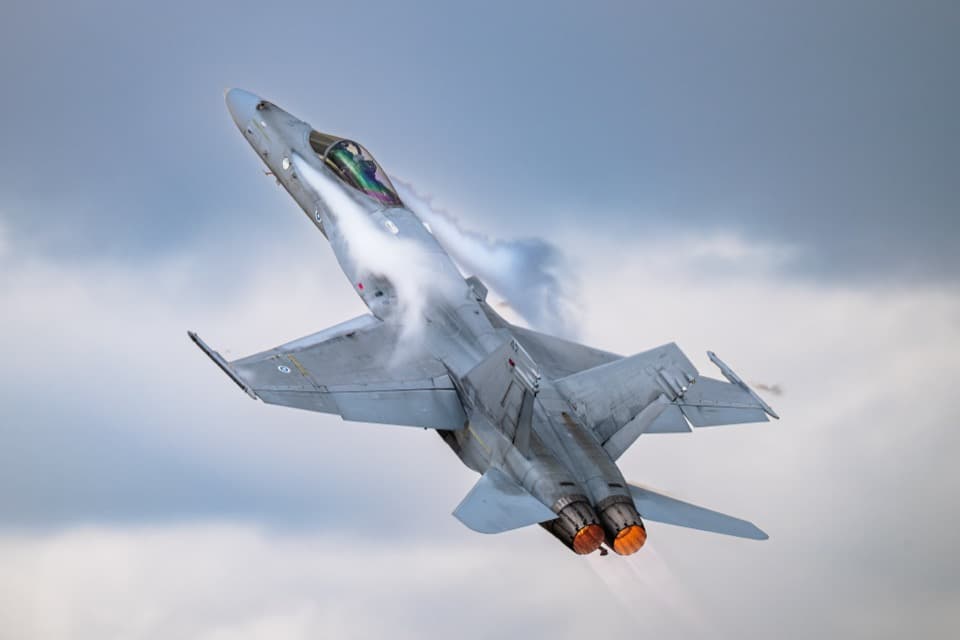
If you want a single pick: the F/A-18C Hornet is the module most likely to keep you flying six months from now. It is a full-fidelity clickable-cockpit jet that does air-to-air, air-to-ground, and carrier work, it has the largest community and therefore the most tutorials, and it is on almost every multiplayer server. The honest caveat: our Hornet checklist runs 130 steps across 14 phases, and you will spend your first several sessions being bad at it. That is the deal. If that sentence makes you tired rather than curious, skip to the Flaming Cliffs section, because the accessible tier exists precisely for you and there is no shame in it.
The rest of this post is why those two paragraphs are true, and the trap that most beginner guides walk you straight into.
Before you buy anything: DCS gives you two aircraft and a trial
What comes free with the base download
DCS World is free-to-play, and the base download is not a demo. It includes two free maps, the Caucasus (a large mission area covering the eastern Black Sea and much of Georgia) and the Mariana Islands, plus two flyable aircraft: the Russian Su-25T ground attack jet and the WWII North American TF-51D. You can fly, fight, and use the mission editor without paying anything.
There is also a new free FC-level Su-25 in development at Eagle Dynamics, which ED has said will be free in the same way the Su-25T and TF-51D are. As of the most recent status report it was still described as nearing completion rather than released, so do not plan your purchase around it.
The 14-day free trial, and the six-month catch
ED lets you test a participating module for two weeks. You can transition from one trial to another, and you can run several at once. The important part is the reactivation rule: once a trial licence is spent, it becomes available again after six months.
That reframes the whole question. You are not asking "which module should I buy first". You are asking "which module should I trial first, and how do I avoid wasting the window". Those are different questions with different answers.
One caveat worth stating honestly: a number of community threads report that the trial is limited to the standalone version of DCS and does not work through Steam. No official ED page states this either way, so treat it as a reported limitation rather than a fact, and check before you plan around it.
How to not waste your trial window
Two weeks sounds generous and is not, because the first four days of a full-fidelity module are spent on startup, not flying.
- Do not trial three aircraft at once out of curiosity. You will spend fourteen days doing three cold starts badly instead of one aircraft properly.
- Have your controls bound before day one. Do not spend the trial in the options menu.
- Trial the aircraft you want, not the one you think you should want. The trial exists to test appeal, and appeal is the thing you cannot research.
- Fly one thing in it end to end. Start, take off, do the mission, land, shut down. If that loop is fun when you are bad at it, it will be fun for years.
The two decisions you are actually making
Most guides give you a ranked list. That hides the fact that there are two independent axes here, and conflating them is why beginners buy wrong.
Fidelity: FC-spec vs full-fidelity clickable cockpit
DCS aircraft come in two tiers.
Full-fidelity modules give you a clickable cockpit where essentially every switch is modelled and does what the real one does. You start the aircraft by flipping switches in the correct order. This is what people mean by "study sim".
FC-spec aircraft (the Flaming Cliffs line) are the accessible tier. In ED's own words they have "less complex controls" while including "their DCS Professional Flight Models", and the concept "allows new and existing players to quickly jump into the action and have fun at an exceptionally advantageous price point". ED explicitly frames it as combat "without having to learn all the systems and a very large number of cockpit inputs typical of the full fidelity aircraft in DCS". The flight model is serious. The cockpit is not clickable.
FC-spec is not a lesser product. It is a different product, aimed at people who want to fly and fight rather than manage systems.
Appeal: the airframe you actually want to fly
This is the axis nobody wants to admit matters, and it is the one that decides whether the module gets flown. If you have wanted to fly a Tomcat since you were nine, buying an A-10C because a forum called it "the beginner one" will not work. You will bounce off it and conclude DCS is not for you, when what actually happened is you bought someone else's dream.
Fidelity is a decision about how you want to spend your time. Appeal is a decision about what you want to be doing. Answer them separately.
Why "buy the easiest one" is bad advice
Difficulty is not the constraint. Motivation is. A hard module you want to fly gets learned; an easy module you do not care about gets refunded. Nobody has ever quit DCS because the startup was too long. They quit because they were doing homework in an aircraft they had no feelings about.
Why most beginner guides still tell you to buy Flaming Cliffs 3
Search this question and you will be told to buy Flaming Cliffs 3. That advice is out of date. FC3 has been superseded by Flaming Cliffs 2024, which is the current product in the FC line, and the guides recommending FC3 by name were mostly written before that happened.
What replaced it, and what that means for you
Flaming Cliffs 2024 carries over the familiar FC lineup: F-15C, A-10A, Su-27, J-11, Su-33, Su-25, MiG-29 and MiG-29S. It adds three new FC-spec aircraft: the F-5E, the F-86F Sabre and the MiG-15bis. Those three have an interesting history. They were originally built for "Modern Air Combat", a planned standalone product ED shelved in 2024, with Matt "Wags" Wagner saying "We've concluded that now is not the time to create a new IP that is separate from DCS". ED has said MAC is not dead, but the work was folded into the FC line instead.
Two practical consequences:
- You do not have to buy the bundle. FC aircraft are now sold individually as FC-dedicated modules, so you can buy a single FC fighter rather than the whole pack.
- Three names now collide, and this trips people up constantly. The F-5E, F-86F and MiG-15bis each exist twice: once as a full-fidelity clickable-cockpit module, and once as the FC-spec version ED added to FC 2024 (sold as F-5E FC, F-86F FC and MiG-15bis FC). An FC-spec F-5E is not the full-fidelity F-5E. When someone recommends "the F-5E", ask which one they mean.
The rest of the FC lineup is a different kind of confusion, and worth getting straight because people conflate the two. There is no full-fidelity A-10A or Su-25 for the FC versions to collide with. The A-10A is an earlier aircraft than the full-fidelity A-10C II rather than a stripped-down version of it, and the FC Su-25 is a different aircraft from the free Su-25T.
On pricing: check the store. Prices change, and any figure quoted here would go stale faster than the rest of this post. The one durable claim is ED's own framing that the FC tier sits at an advantageous price point relative to full-fidelity modules.
The shortlist
A framework plus five routes in. The store has 50+ aircraft and any exhaustive list rots within a year.
If you want the modern multirole experience: F/A-18C Hornet
The default recommendation for good reason. The F/A-18C Hornet does everything, has the deepest tutorial coverage of any module, and carrier operations give you a skill to chase for years. Downside: it is genuinely complex, the systems depth means you are always slightly behind the aircraft for the first month, and carrier landings will bruise your ego on a schedule.
The F-16C Viper is the obvious alternative if you prefer the airframe. It is broadly comparable in learning curve (122 steps in our checklist against the Hornet's 130). Pick on appeal, not on step count.
If you want to learn systems deeply: A-10C II Thunderbolt
The A-10C II Thunderbolt is the module for people who enjoy the process. It rewards methodical work, its sensors and weapons employment are deeply modelled, and it is slow enough that you have time to think. Downside: it is slow enough that you have time to think. If you want air-to-air, this is the wrong aircraft, and the avionics workload is real rather than themed.
Note carefully: this is the full-fidelity A-10C II. The A-10A that ships in Flaming Cliffs 2024 is a separate product and an older aircraft, not an easier version of the same jet.
If you want to fly, not manage: Flaming Cliffs 2024 (or one FC aircraft)
If the appeal of DCS is flying and fighting rather than switchology, the FC tier is the correct answer and not a compromise. FC 2024 spans the Su-27, the FC-spec F-86F Sabre and MiG-15bis, an FC-spec Su-25 (our Su-25A checklist), and the F-15C, A-10A, J-11, Su-33 and MiG-29. Downside: the non-clickable cockpit has a ceiling. If you later want full-fidelity depth, you buy a second module rather than upgrading this one.
Our checklists for those airframes are the full-fidelity procedures where a full-fidelity module exists, so they run deeper than the FC-spec version requires. They are still the best way to understand what the aircraft is actually doing.
If you want a fight, not a cockpit: F-5E Tiger II
The F-5E Tiger II is a small, honest, gun-and-Sidewinder jet with no radar to hide behind. It teaches you to fly, because there is nothing else to do. Downside: you will lose a lot of fights to better-equipped aircraft, and the lack of modern sensors means you have to actually be good.
Again, the naming trap: our checklist covers the full-fidelity F-5E, and FC 2024 ships a separate FC-spec F-5E. Different products.
If you want no jet at all
Nobody has to start in a jet. The P-51D Mustang is 102 steps and the flying is the whole point. The UH-1H Huey at 123 steps is the classic helicopter entry, and helicopters are hard in a way that is completely different from jets: the challenge is in your hands, not in a menu. Downside on both: the busiest public servers are mostly built around modern jets, so WWII and helicopter flying tends to live on servers dedicated to it. That is a smaller pool to find people in, not an empty one.
The full DCS fleet has every aircraft we have a checklist for if you want to browse the airframe that actually appeals to you.
What "free" costs you: the Su-25T reality check
Every beginner guide points you at the free Su-25T as the gentle on-ramp. This is where free gets confused with easy, and the two are unrelated.
The Su-25T is a Soviet cold-start aircraft. To start it properly you turn on the PNK navigation system, set the mode selector to INU, and then hold the aircraft completely stationary for approximately three minutes while the inertial platform aligns. Our checklist carries the caution verbatim: "Do not move the aircraft during INS alignment. Any movement degrades navigation accuracy." You cannot taxi. You sit there.
It also has no radar, so target identification is visual, which shapes how you have to fly the entire mission. Its Vikhr ATGMs require the Shkval electro-optical system to be active before they will do anything. Internal fuel is roughly 3,600 kg, and low-level CAS burns through it.
For a single honest comparison: our Su-25T checklist runs 172 steps, and our F/A-18C checklist runs 130. Read that carefully, because it is not a fidelity ranking. Those are our numbers, reflecting how we break a procedure into steps, and the Su-25T total includes an 8-step pre-flight planning phase that is mission briefing rather than switch actuation. The point is not that the Su-25T is harder than the Hornet. The point is that the free aircraft is not the simple aircraft, and anyone who told you otherwise was reasoning from the price tag.
Fly it. It is a good jet and it costs nothing. Just do not expect it to be a tutorial.
Controls matter more than the module
If you are choosing between a second module and your first joystick, buy the joystick. This is not close.
DCS on a keyboard is a bad experience in any aircraft, at any fidelity tier. Analogue pitch and roll are not a luxury here, they are the difference between flying and inputting commands. A modest stick with a twist axis for rudder will do more for your enjoyment than any module upgrade, and the difference shows up in the first ten minutes rather than after a learning curve. Every module recommendation above assumes you have one.
Common first-purchase mistakes
- Buying three modules in a sale. You will learn none of them. One module, learned properly, is worth more than a hangar you cannot start.
- Buying the module a forum told you to buy. See the appeal axis. Their dream aircraft is not yours.
- Buying before trialling. The trial exists and resets after six months. Use it.
- Assuming free means beginner-friendly. See the Su-25T above.
- Buying an FC aircraft expecting a clickable cockpit, or a full-fidelity aircraft expecting to jump in and fly. The two tiers share names. Check which one you are looking at.
- Buying a map or a campaign before the aircraft. The base Caucasus map is large and free. It is not your bottleneck yet.
On waiting for a sale: ED's own FAQ says nothing about seasonal sales or discount cadence, so "wait for the sale" is community practice rather than documented fact. Treat it as folklore that is probably useful, not as a schedule.
FAQ
Is Flaming Cliffs good for beginners?
Yes, if the accessible tier is what you want. The current product is Flaming Cliffs 2024, not FC3, and it now includes FC-spec F-5E, F-86F and MiG-15bis alongside the older lineup. You can also buy FC aircraft individually rather than as a pack. It is a poor choice only if you specifically want a clickable cockpit, which it does not have by design.
Should I buy FC3 first?
The guides saying this were written before Flaming Cliffs 2024 existed. FC 2024 is the current FC product and adds three aircraft over the old lineup. Look at FC 2024, or at a single FC-dedicated module, rather than following advice written for a superseded product.
Is the free Su-25T a good first aircraft?
It is a good aircraft and it costs nothing, so fly it. It is not, however, a simple one: it needs a roughly three-minute stationary INS alignment before you can taxi, and it has no radar. Free is a price, not a difficulty tier.
What is the actual best first module to buy?
The one you want to fly, tested with the free trial first. If you need that narrowed: F/A-18C for modern multirole, A-10C II for systems depth, an FC aircraft if you want to skip switchology, F-5E if you want pure flying. All of them work. The one that fails is the one you bought because someone else liked it.
How many aircraft do I need?
One. For a long time. DCS depth is vertical, not horizontal, and the pilots having the most fun are usually the ones flying one airframe well.